


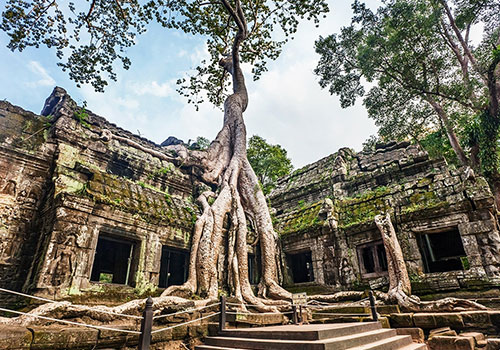
Exploring Ta Prohm offers visitors a glimpse into the past, with intricate carvings, courtyards, and corridors partially obscured by the encroaching vegetation.
Despite its state of semi-ruin, the temple remains one of the most popular and captivating attractions in the Angkor Archaeological Park, drawing tourists and scholars alike to marvel at its beauty and history.
Ta Prohm Temple in Siemreap of Cambodia. It’s a fascinating temple complex built in the 12th century in the Angkor region.
Ta Prohm is renowned for its atmospheric beauty, with ancient trees intertwining with the temple ruins, creating a stunning blend of nature and architecture.
It gained further fame after being featured in the movie “Tomb Raider.”
Ta Prohm Temple, originally known as Rajavihara, was built by the Khmer King Jayavarman VII in the late 12th and early 13th centuries.
It was dedicated to the king’s mother and served as a Mahayana Buddhist monastery and university.
What sets Ta Prohm apart is its unique architectural style and the way it has been left largely unrestored, allowing nature to reclaim the site.
The temple is enveloped by massive fig and silk-cotton trees, their roots winding through the ruins, giving it a surreal, overgrown appearance.
The design of Ta Prohm is that of a typical “flat” Khmer temple, as opposed to a temple-pyramid or temple-mountain, the inner levels of which are higher than the outer.
Five rectangular enclosing walls surround a central sanctuary.
The sanctuary is centered around the stone face of Prajnaparamita, the personification of wisdom, modeled after the king’s mother.
Like most Khmer temples, Ta Prohm is oriented to the east, so the temple proper is set back to the west along an elongated east–west axis.
The outer wall of 1000 by 650m encloses an area of 650,000 square metre that at one time would have been the site of a substantial town.
