


Angkor Wat Temple
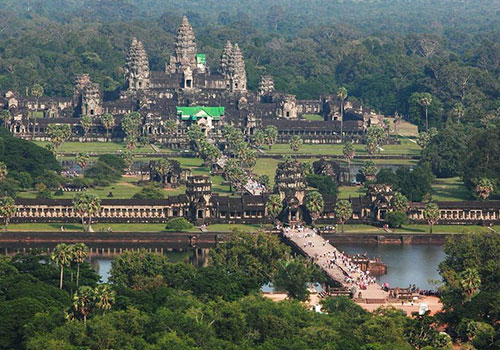
Angkor, the great medieval city located near the Tonlé Sap (the “Great Lake”) in northwestern Cambodia, was abandoned by Khmer rulers in the fifteenth century in an effort to find a capital that could be more easily defended against the expansionistic Thais. In the ensuing centuring – called the first “dark age” of Khmer history (the second being that instituted by the Khmer Rouge under Pol pot) – Angkor become a ruin, destroyed as much by the inexorable expansion of nature as by the destructive acts of humans. Although it was never really lost to Khmers, who recalled the past glories of Angkor in folktales, it ceased to be the cultural center of Khmer civilization after the fifteenth century.
In 1860 the French explorer Henri Mouhot made his way to ancient ruins surrounded by jungle in the vicinity of the Tonlé Sap. Mouhot has sometimes been wrongly credited with having discovered Angkor, but his description of the ruins in his Le Tour du Monde did awaken the outside world to one of the great architectural wonders of history. Mouhot’s “discovery” ushered in a period of interest French interest in Angkor, an interest that led the French government to support, through that Ecole Francaise d’Extrême-Orient, archaeological and historical researches into the character of Angkorean civilization. In the twentieth century, the colonial government of Indochina also contributed considerable funds toward Angkor’s reconstruction.
Angkor, which is a Khmer version of the Sanskrit term nagara (“city”), was in fact a succession of sacred cities that served as the capital of the rulers of an empire from the ninth o the fifteenth centuries. Each pyramidal-shaped structure or temple that we so associate with Angkor was a re-creation in stone of the cosmology by which the Khmer rulers ordered their lives and that of their subjects.
