


Bayon Temple
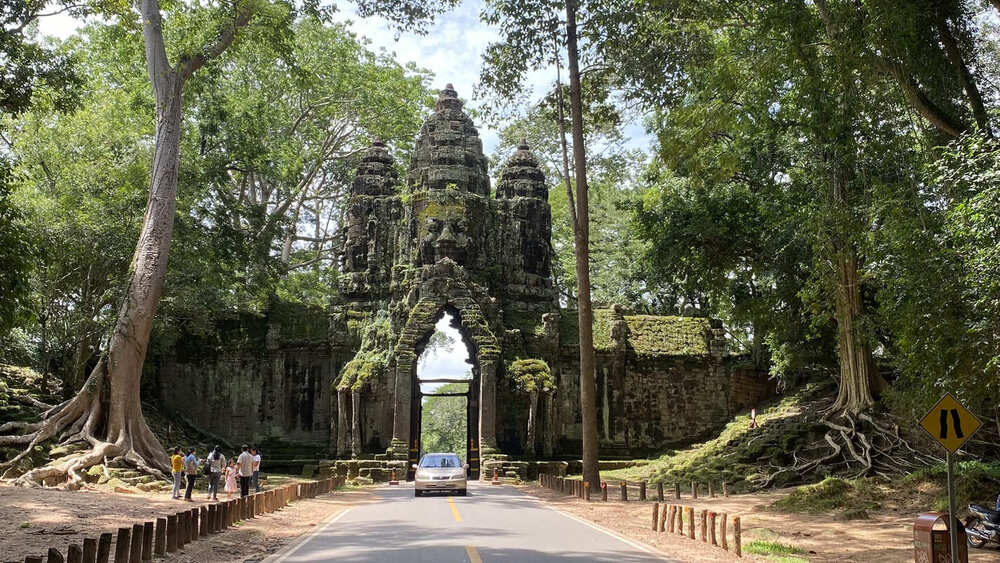
Location: in the Center of the city of Angkor Thom, 1.5 kilometres (1 mile) from the south gate
Access: enter from the east
Date: late 12th century to early 13th century
King: Jayavarman VII (reigned 1181-1120)
Religion: Buddhist
Art style: Bayon
The Bayon vies with Angkor Wat as the favourite monument among visitors. The two temples evoke similar aesthetic responses yet are different in purpose, design, architecture and decoration.
The dense jungle surrounding the temple camouflaged its position in relation to other structures at Angkor, so it was not known for some time that the Bayon stands in the exact geographical centre of the city of Angkor Thom.
Even after topographical maps finally revealed its correct location, the Bayon was erroneously identified as a Hindu temple connected with the city of Yasovarman I, and, thus, dated to the ninth century.
A fronton found in 1925 depicting an Avalokiteshvara, identified the Bayon as a Buddhist temple. This discovery moved the date of the monument ahead some 300 years to the late 12th century.
Although the date is firmly supported by archaeological evidence, the Bayon remains one of the most enigmatic temples of the Angkor group.
Its symbolism, original form, subsequent changes and additions have not yet been understood. These aspects leave us today with a complicated, crowded plan that challenges both archaeologists and historians.
The Bayon was built nearly 100 years after Angkor Wat. While its basic structure and earliest part of the temple are unknown, it is clear that the Bayon was built on top of an earlier monument, that the temple was not built at one time, and that it underwent a series of changes.
